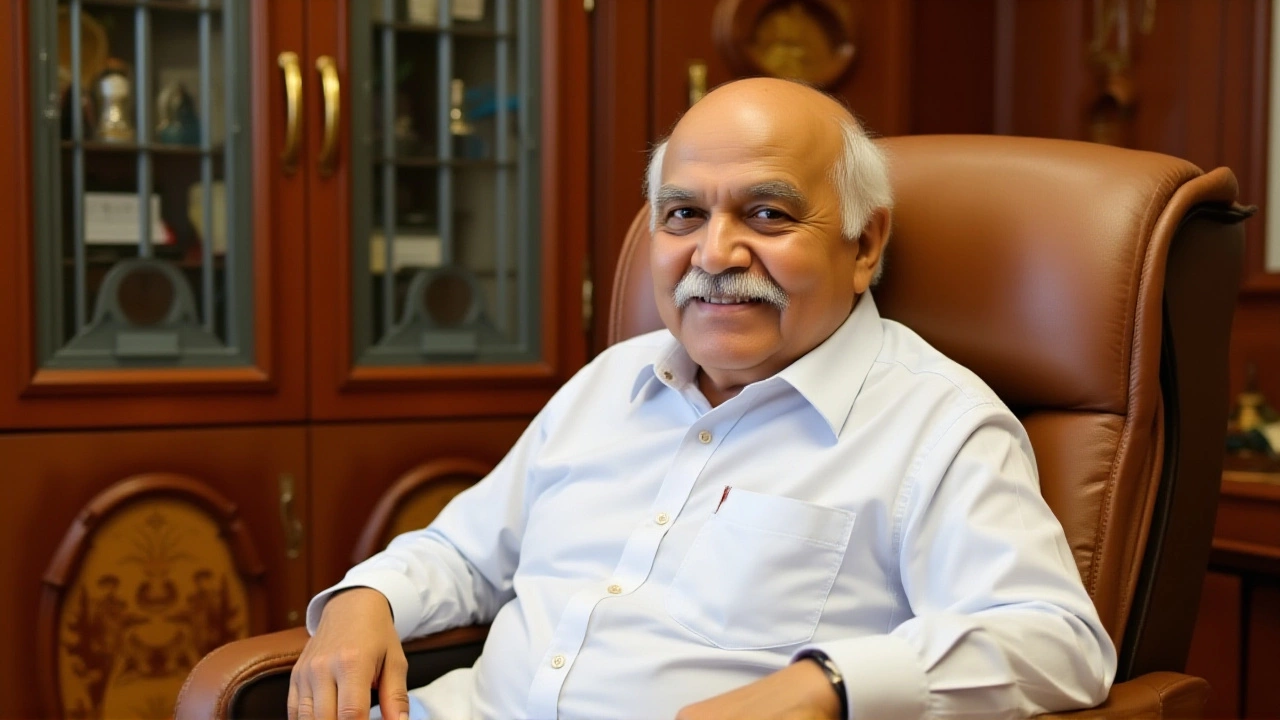
On November 17, 2025, under a sky streaked with twilight over Hyderabad’s sprawling Ramoji Film City, seven ordinary people who did extraordinary things were handed medals not just for achievement—but for character. The inaugural Ramoji Excellence Awards 2025 wasn’t just a ceremony. It was a quiet revolution in public recognition, honoring those who build nations one well, one school, one truth at a time—without fanfare, without political backing, and often without paychecks. The event, organized by the Ramoji Foundation in memory of the late media titan Sri Ramoji Rao, felt less like an awards night and more like a family gathering where the whole country was invited to say thank you.
A Legacy Turned Living Tribute
Sri Ramoji Rao, the Padma Vibhushan-winning founder of the Ramoji Group, didn’t just build film studios. He built institutions that gave voice to the voiceless. His legacy isn’t measured in box office numbers but in the millions of Telugu speakers who learned to read through his newspapers, or rural children who watched educational TV programs beamed from his studios. The awards were conceived on the anniversary of his birth, a deliberate choice—not to mourn him, but to make sure his values didn’t die with him. Vice President C. P. Radhakrishnan, the evening’s Chief Guest, captured it best: “He turned dreams into enduring institutions.” And that’s exactly what the awards aim to do: turn quiet heroism into public inspiration.The Awardees: Quiet Heroes, Loud Impact
Of the seven recipients, none drew more emotional applause than Amla Ashok Ruia, known across India as “India’s Water Mother.” She received the Excellence in Rural Development award for her 25-year crusade to bring clean water to over 800 drought-stricken villages in Rajasthan, Madhya Pradesh, and Maharashtra. No government grants. No corporate sponsorships. Just her, a team of engineers, and a belief that water is a right, not a privilege. “She didn’t wait for permission,” said one villager from Bundelkhand, who traveled 400 kilometers to be there. “She showed up with a shovel and a prayer. And then she made the earth cry with joy.” Others honored included a tribal educator from Odisha who started a school inside a forest grove, a scientist who developed low-cost solar water purifiers now used in 12 states, and a journalist who spent a decade documenting caste-based discrimination in rural courts—risking her life to publish the truth.Leadership in the Room: More Than Protocol
The presence of Chief Minister A. Revanth Reddy and Chief Minister N. Chandrababu Naidu wasn’t political theater. It was a rare moment of unity. Naidu, speaking the day before, remarked: “Ramoji Rao never asked any favor from the government. He prioritized journalistic freedom above all else.” That line echoed through the crowd. In an era where media is often accused of being bought or bullied, here was a man who refused to bend. Former Chief Justice Justice N. V. Ramana quietly slipped into the front row. He didn’t speak. But his presence said everything: this was about justice—not the kind handed down in courtrooms, but the kind built in village squares.The Ramoji Dictionary: A Cultural Lifeline
One of the evening’s most underreported moments was the launch of the Ramoji Dictionary—two editions: English-to-Telugu and Telugu-to-Telugu. It’s not just a glossary. It’s a lifeline. In a country where 70% of rural children grow up speaking dialects not captured in textbooks, this dictionary includes idioms, proverbs, and even agricultural terms passed down orally for generations. For many, it’s the first time their grandmother’s words are written down with dignity. “It’s not about translation,” said linguist Dr. Priya Srinivasan, who advised on the project. “It’s about validation. When a language has a dictionary, it says: ‘You matter.’”What Comes Next?
The Ramoji Foundation has already announced the next edition will be held on November 16, 2026, again at Ramoji Film City. This time, they’re opening nominations to the public—a first for any Indian award of this scale. “We want the people to choose who inspires them,” said Sri Kiron, Managing Director of the Ramoji Group and son of the late Ramoji Rao. “Not the media. Not the politicians. The people.” The awards aren’t cash prizes. They’re bronze busts, handwritten letters from villagers, and a year-long mentorship with India’s top NGOs. The message is clear: recognition, not reward, is the true currency of legacy.Why This Matters
In a time when headlines scream about scandals, elections, and controversies, the Ramoji Excellence Awards whispered something different: heroism is still alive. It’s not in boardrooms or TV debates. It’s in the woman who walks 10 kilometers daily to teach children under a tree. In the man who fixes hand pumps with spare parts from junkyards. In the journalist who files stories no one else dares to print. This wasn’t just an awards night. It was a mirror. And for the first time in a long while, India saw itself—and liked what it saw.Frequently Asked Questions
Who is Amla Ashok Ruia and why was she called 'India's Water Mother'?
Amla Ashok Ruia is a social activist who has spent over 25 years restoring water security to 800+ drought-hit villages across India, primarily in Rajasthan, Madhya Pradesh, and Maharashtra. She pioneered community-led rainwater harvesting systems using low-cost, locally sourced materials, often working without government funding. Villagers began calling her 'India's Water Mother' after she helped revive dried-up wells and enabled entire communities to grow crops again, reducing migration and improving child nutrition.
What makes the Ramoji Excellence Awards different from other Indian awards?
Unlike most Indian awards that focus on celebrities or corporate leaders, the Ramoji Excellence Awards honor grassroots changemakers—teachers, farmers, journalists, engineers—who work silently for decades. There are no cash prizes; recipients receive bronze busts, handwritten letters from beneficiaries, and mentorship from NGOs. The selection process is curated by a panel of retired judges, educators, and community leaders, not media houses or corporations.
Why was the Ramoji Dictionary launched, and why is it significant?
The Ramoji Dictionary includes over 12,000 Telugu words, many of which are dialect-specific or related to agriculture, folk medicine, and daily life, previously undocumented in formal dictionaries. It’s significant because it preserves linguistic heritage at risk of disappearing as younger generations shift to English or Hindi. The Telugu-to-Telugu edition, in particular, helps rural learners understand complex concepts in their mother tongue, improving literacy and cultural pride.
How did Sri Ramoji Rao influence Indian media and journalism?
Sri Ramoji Rao built India’s largest film studio, Ramoji Film City, and founded newspapers and TV channels that gave voice to regional languages and rural perspectives. He famously refused government ads unless editorial independence was guaranteed. His media empire became a model for ethical journalism—prioritizing truth over ratings. Former Chief Minister Naidu noted that even an hour-long conversation with him could clarify complex issues, highlighting his integrity and vision.
Where will the next Ramoji Excellence Awards be held, and how can someone be nominated?
The 2026 ceremony will be held on November 16 at Ramoji Film City in Hyderabad, Telangana. For the first time, the Ramoji Foundation is opening public nominations via its website, allowing any Indian citizen to submit a name of a grassroots changemaker who has demonstrated integrity, innovation, and service for at least 10 years. Nominations close on August 31, 2026.
Why were both Telangana and Andhra Pradesh Chief Ministers present?
Sri Ramoji Rao’s legacy transcends state lines—he was born in Andhra Pradesh but built his empire in Hyderabad, now in Telangana. His media outlets served both states equally, and his film city is a shared cultural landmark. Their joint presence symbolized unity in honoring a figure who never let political boundaries define his mission. Both CMs praised his refusal to seek political favors, reinforcing his image as a true public servant.